

Before You Say "Can I Be Honest With You?" Ask Yourself This Instead.
The truth does not need a disclaimer. Before a difficult conversation, ask whether you know enough, need more context, or need to say it at all.
Keynote Speaker: Helping pros stay HUMAN and Break Free of the Sea of Sameness
The truth doesn't need a disclaimer. And honesty isn't a mode you switch into.
Have you ever caught yourself beginning a conversation with one of these phrases?
"Can I be honest with you?" "If I'm being honest..." "Honestly..."
They sound harmless. You might even believe you're demonstrating transparency, sincerity, or a willingness to have a difficult conversation. But consider what happens on the receiving end.
The moment you announce that you're about to be honest, you introduce a question that wasn't necessarily there before. Wait. Were you not being honest with me before? What else haven't you told me? What are you holding back?
Suddenly, a phrase intended to establish trust has the potential to introduce doubt. And in business, leadership, sales, and relationships, those seemingly insignificant communication choices matter.
Why Do People Say "Can I Be Honest With You?"
Most people aren't intentionally creating doubt. Often, they're attempting to gain permission to say something difficult, uncomfortable, or potentially unwelcome.
Think about the conversations you navigate as a leader. You need to address someone's performance. You disagree with a colleague's decision. You have information a client may not want to hear. You recognize something that needs to be addressed, but you're unsure how the other person will receive it.
So you reach for a familiar preface: "Can I be honest with you?"
It's almost as if you're asking permission to temporarily step into honesty. But honesty shouldn't require an announcement.
Honesty is not a mode you switch into. It should already be the baseline of the relationship.
The question isn't whether you're allowed to be honest. The more important question is whether you have enough context to determine what needs to be said in the first place.

Before You Say Something Difficult, Consider These Three Possibilities
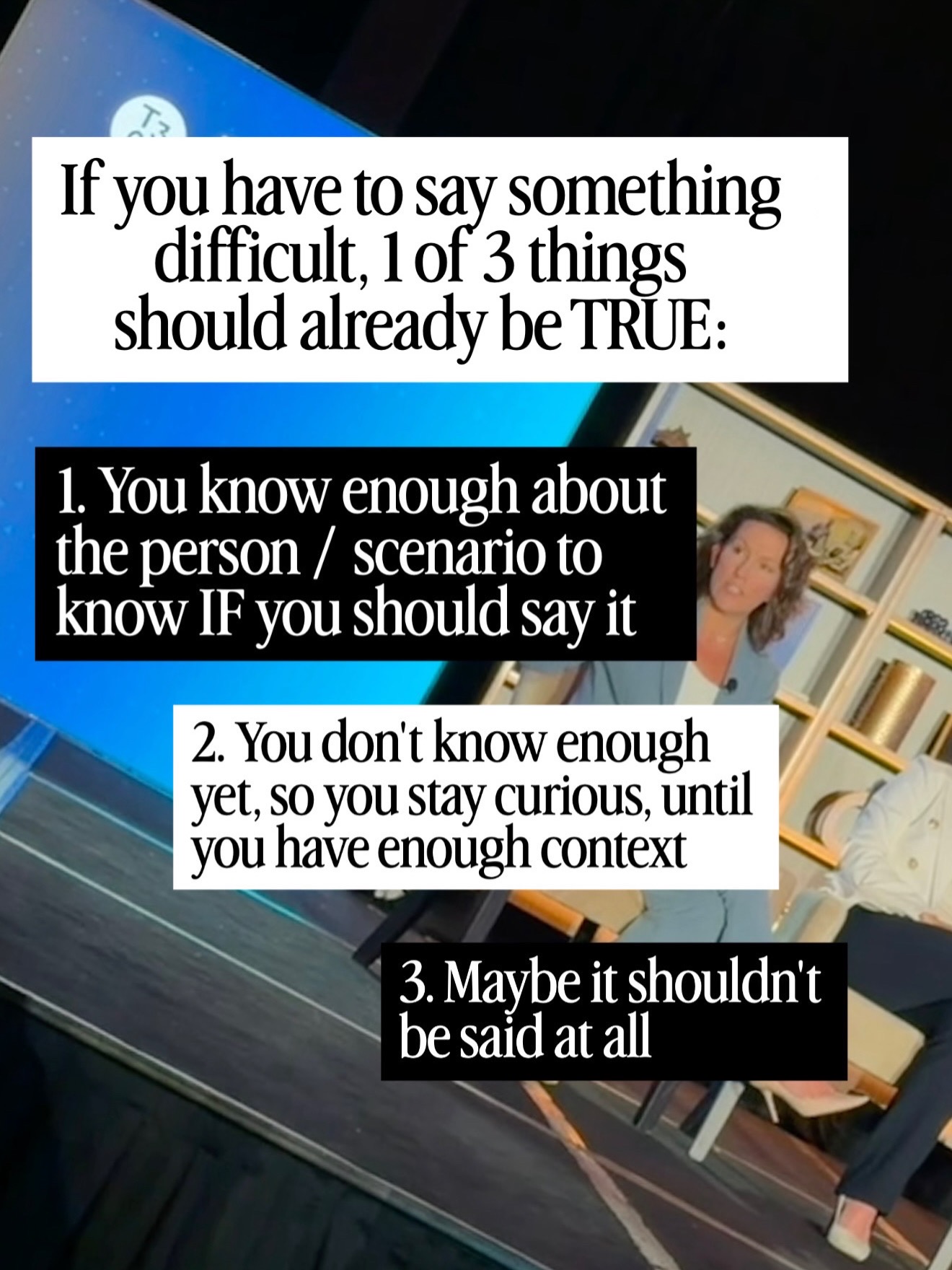
During a recent leadership panel at the T3 Leadership Summit, I shared a simple framework for approaching difficult conversations.
Before delivering an uncomfortable message, one of three things should already be true.
1. You know enough about the person or situation to know IF you should say it.
You have the context. You understand the circumstances. You've considered the purpose of the conversation. Now, it's time to communicate.
Perhaps an employee needs direct feedback. A client needs information that could influence their decision. A colleague needs to understand how their actions are affecting others.
You don't need to hide behind an announcement that honesty is coming. Be clear. Be thoughtful. Be direct.
And remember, knowing something needs to be said doesn't eliminate your responsibility to consider HOW you say it. Direct communication and consideration for another person can coexist.
2. You don't know enough yet, so you stay curious until you have enough context.
This is where communication can become particularly powerful.
How often do people rush to deliver an opinion before they've taken the time to understand the full situation? You see a behavior. You make an assumption. You form a conclusion. And then you prepare to deliver your version of the truth.
But what if you're missing something important?
Before offering an opinion, consider asking:
- "Help me understand what led to that decision."
- "What am I missing?"
- "What have you considered that I may not be aware of?"
- "What would be helpful for me to understand before offering my perspective?"
Curiosity creates room for information you don't yet have. Sometimes, one additional question completely changes the conversation you thought you needed to have.
Curiosity is a super power. Especially when you're convinced you already know the answer.
3. Maybe it shouldn't be said at all.
Not every observation requires commentary. Not every opinion needs an audience. And not every uncomfortable thought deserves to become someone else's uncomfortable conversation.
Ask yourself whether what you're about to share is necessary, helpful, and intended to serve the other person. Or are you simply saying it because you want to get something off your chest?
There is a difference between communicating something difficult because it matters and saying something simply because you can.
Discernment is a communication skill, too.
The Simple Swap: Replace the Disclaimer With Curiosity
This isn't about finding a more polished way to say, "Can I be honest with you?" It's about recognizing what needs to happen BEFORE the words leave your mouth.
Instead of automatically prefacing a difficult conversation with "Can I be honest with you?", consider three questions:
- Do I know enough to offer my perspective?
- Would another question help me better understand?
- Does this actually need to be said?
Sometimes the appropriate next step is a direct conversation. Sometimes it's silence. And sometimes it's another question.
The ability to recognize the difference is an important part of becoming a more intentional communicator.
The Words You Choose Matter. So Does the Curiosity Behind Them.
Whether you're leading a team, serving a client, navigating a difficult relationship, or participating in an important conversation, the goal isn't to become someone who always knows exactly what to say.
It's to become someone who recognizes when to speak, when to listen, and when to ask a better question.
Because communication isn't simply about delivering information. It's about understanding the person receiving it. And protecting trust requires more than announcing your good intentions. It requires consistency in how you communicate, particularly when the conversation becomes uncomfortable.
The next time you find yourself preparing to say, "Can I be honest with you?" PAUSE.
You have three choices: Say it. Don't say it. Or revert to CURIOSITY.
The answer isn't necessarily in a better preface. The answer may be in a better question.
Keep reading
Related notes

What Do You Want to Be Known For?
Two moments, almost a decade apart, that changed how I think about identity, cascading impact, and giving yourself permission to evolve.

Silently Starving
What have you been quietly hungry for that you haven't yet given yourself permission to say out loud?

The Becoming Quadrant
Ever feel uncomfortable during a season of change? Don't worry, you aren't alone.